
Crypto Governance Analytics: What On-Chain Voting Really Says About Risk
Author
CoinIQ
Date Published

Governance is not boring. It is where risk often starts
Governance has a dreadful reputation problem in crypto. Traders find it too slow. Builders often see it as admin. Casual observers treat it like the broccoli of the ecosystem. Important, yes, but not exactly the bit anyone rushes towards.
That is a mistake.
Governance is one of the clearest places to spot how power actually works inside a crypto project. It shapes treasury management, token emissions, incentive design, emergency actions, grants, partnerships and sometimes even basic security decisions. When governance is healthy, protocols are more likely to respond sensibly under pressure. When it is weak, captured or performative, problems can build quietly until they become impossible to ignore.
For investors, that makes governance far more than a community side-show. It is a genuine source of operational and portfolio risk.
What on-chain voting really reveals
Most people look at a governance proposal and focus only on the result. Passed. Rejected. Delayed. End of story.
But the interesting information is often hidden in the voting pattern itself.
Who voted? How concentrated was power? Did turnout come from a wide range of token holders, or from the usual small circle of delegates and insiders? Was the result convincing because the community participated, or because three very large wallets had a productive Wednesday?
These details matter because governance tells you how decisions are likely to be made in the future. A protocol with broad participation and healthy delegate turnover may be better equipped to handle disagreement and adapt over time. A protocol where the same small group dominates each major decision may look decentralised on the surface while behaving more like a private members’ club.
That distinction is not philosophical. It affects risk.
Why decentralisation needs measurement, not mythology
Crypto loves to talk about decentralisation as if it were a neat badge a project either has or does not have. In reality, decentralisation is far messier than that. It behaves more like a dimmer switch.
Some protocols have a broad token base but low participation. Some have active governance but heavy delegate concentration. Some have open voting systems where the outcome is effectively decided before the wider community has put the kettle on. Others genuinely distribute influence over time. Without proper measurement, all of these can end up marketed in exactly the same language.
That is why governance analytics matters. It gives users a way to test whether a protocol’s decision-making is genuinely distributed or merely cosmetically so. It replaces vibes with evidence, which is always a healthy development in a market that occasionally treats vibes as a full accounting standard.
The governance metrics that deserve more attention
If governance is going to be useful as an analytical signal, it needs to be broken into practical metrics that investors can interpret quickly.
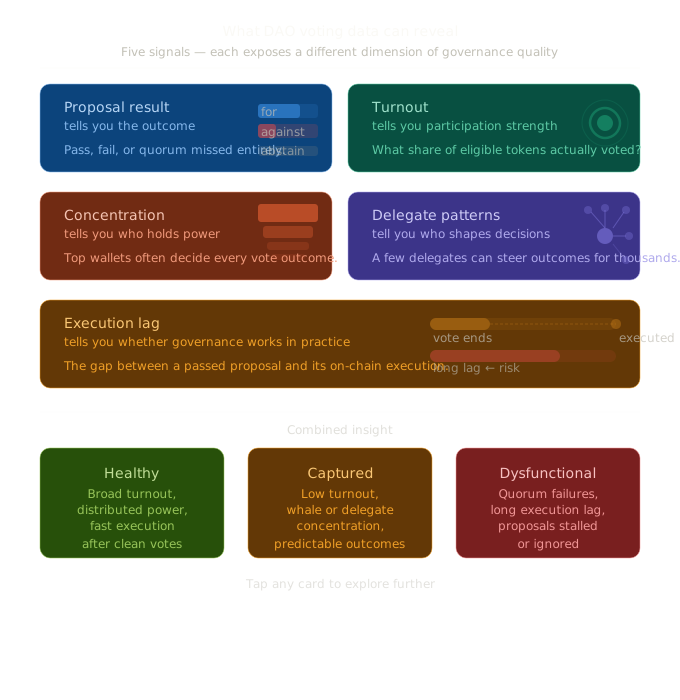
- Voting power concentration: How much influence sits with the top wallets or top delegates? A high concentration level may indicate that governance outcomes are vulnerable to a narrow decision-making bloc.
- Turnout quality: Turnout on its own is not enough. The more important question is whether participation is broad-based. A proposal with high turnout driven mainly by insiders is very different from one supported by a wide spread of token holders.
- Delegate dominance: Do the same delegates repeatedly shape the outcome of major decisions? Persistent dominance can suggest that influence is becoming entrenched rather than distributed.
- Proposal quality: A healthy governance system should focus attention on material strategic questions. If token holders are buried under endless low-value administration, participation often falls and real oversight weakens.
- Execution lag: How quickly are approved decisions actually implemented? A governance framework that passes proposals but struggles to execute them can create a dangerous gap between intention and reality.
- Governance churn: Is influence becoming more distributed over time, or hardening around the same actors? This helps users judge whether decentralisation is improving or quietly moving in reverse.
Why governance concentration can affect returns
Governance concentration is one of the most underrated risks in crypto. When a small group can steer treasury deployment, token incentives or emergency responses, the protocol becomes more vulnerable to narrow interests, rushed decisions and poor accountability.
That matters for markets because governance decisions often sit upstream of financial outcomes. A badly designed emissions change can affect token pressure. A weak treasury decision can alter runway. A delayed response to a security incident can damage confidence. A governance system that cannot resolve disputes cleanly can grind protocol development to a halt. In other words, voting data is not just community sentiment wearing a rosette. It is often early-warning data.
This is where a governance dashboard becomes genuinely valuable. Rather than expecting users to inspect every proposal manually, analytics can track participation patterns, power concentration, execution speed and delegate behaviour in one place. That turns governance from something investors vaguely know they should care about into something they can actually use in portfolio analysis.
What healthy DAO governance looks like
Healthy governance does not require perfection. It does not mean every token holder votes on every issue with saintly dedication. That would be lovely, but so would a London flat with reasonable rent and a roof terrace.
What it does require is a system where influence is visible, participation is credible, major proposals are understandable and decisions are implemented with reasonable speed. Good governance reduces uncertainty. It gives participants confidence that disagreements can be handled without chaos and that protocol changes will not be dictated by a tiny unaccountable group.
That is especially important as DAOs mature. The more assets, users and treasury responsibilities they manage, the less room there is for governance to remain a theatrical accessory. It has to function as infrastructure.
Governance analytics should become a standard risk lens
Crypto has become much better at measuring price, volume, volatility and liquidity. It is still far less consistent at measuring who actually controls decision-making. That gap matters because strong-looking protocols can still carry hidden governance fragility.
The next step for serious analytics platforms is to treat governance as a standard risk lens rather than a specialist niche. If a protocol’s future depends on treasury votes, delegate incentives, emission changes and emergency proposals, then those signals belong in the same conversation as market data and on-chain flows.
That is the real shift. Governance should not sit at the edge of analysis as a worthy footnote. It should sit much closer to the centre, where it can do what it does best: reveal how a protocol is likely to behave when things stop going smoothly.
And in crypto, that sort of information is rarely boring for long.

Discover if there's an optimal time for buying or selling cryptocurrency and learn what could be used to determine accurate valuations.

Best crypto portfolio management tools for retail investors compared - learn how CoinIQ delivers smarter, unified portfolio insights.

How stablecoins are possibly reinventing the dollar, reshaping global finance, and quietly powering U.S. economic strategy