
AI Agents in Crypto Analytics: Are We Measuring Users or Just Well-Dressed Bots?
Author
CoinIQ
Date Published

AI agents are changing what on-chain activity means
Crypto has always loved a big number. More wallets. More transactions. More protocol interactions. More charts shooting upwards like they have just remembered they left the hob on.
For years, investors have treated these figures as a rough shortcut for adoption. If activity rises, interest must be growing. If active wallets surge, demand must be strengthening. Simple enough. The problem is that crypto is no longer populated only by humans clicking around after a coffee and a questionable Twitter thread.
AI agents are becoming more active across trading, portfolio management, yield strategies, governance participation and automated execution. They can monitor markets, rebalance positions, sweep incentives, move assets across chains and interact with protocols all day without needing sleep, lunch or a nervous lie down. That means a growing share of on-chain activity may be generated by software rather than by independent users making messy human decisions.
This does not mean the data is useless. It means the interpretation has changed. If one hundred people use a protocol because they find it genuinely valuable, that says one thing. If ten automated agents hammer the same protocol all week because the incentives are attractive, that says something else entirely. Both create activity. Only one necessarily points to broad organic demand.
Why active wallets and transaction counts can mislead
The old assumption was straightforward. More active addresses meant more users. Higher transaction counts meant more engagement. Bigger volume meant deeper adoption. That framework worked reasonably well when most activity reflected direct human participation.
Now it needs an update.
AI agents can repeat behaviour with remarkable consistency. They can open, close, rotate, swap, bridge and harvest in patterns that make a network look bustling even when very little genuine user growth is taking place. It is a bit like judging the popularity of a shopping centre by counting how often the automatic doors open. Useful at a glance, yes. Conclusive, not remotely.
This creates a problem for analysts, investors and protocol teams alike. A project might celebrate a sharp rise in daily activity, but if that growth is driven mainly by automated wallets chasing temporary conditions, the signal can be far weaker than it appears. In some cases, the busiest protocols may simply be the ones most attractive to bots.
That matters because investors allocate capital based on these signals. Founders use them in pitches. Researchers use them in market commentary. If the underlying meaning of activity has changed, analytics platforms need to change with it.
What real demand looks like in crypto analytics
Real demand usually leaves a more varied footprint than automated activity. Humans are gloriously inconsistent. They arrive in uneven waves. They test products, disappear, come back later, increase or reduce position sizes, panic at the wrong moment, and occasionally make decisions that no spreadsheet would ever approve.
Automated agents tend to behave differently. Their timing is tighter. Their patterns are more repeatable. Their capital rotation may look cleaner, more disciplined and more suspiciously symmetrical than normal retail or institutional behaviour. Again, that does not make them bad. It simply means they should not be confused with human adoption.
For a crypto analytics platform, this is where the interesting work begins. Rather than focusing only on raw activity totals, the more useful approach is to analyse the quality of participation.
A stronger framework might ask:
- Are wallets behaving with meaningful variety, or repeating near-identical actions?
- Is the capital per interaction rising, or are there thousands of tiny low-value transactions?
- Do users return after incentives end, or vanish like free samples at a supermarket?
- Are wallets exploring product features more deeply over time, or simply cycling through one profitable action?
- Does protocol usage broaden across new cohorts, or remain concentrated in a narrow group of highly active participants?
These questions get closer to the heart of adoption. They move beyond noise and towards intent.
The metrics that matter more in the age of AI agents
If crypto analytics is going to stay useful, it needs to prioritise behavioural signals over vanity counts. The goal is not merely to measure activity, but to understand what kind of activity is taking place.
Here are five metrics that deserve more attention.
- Behavioural diversity: When users behave in a wide range of ways, it often suggests real product engagement. Some hold, some trade, some stake, some test features, some withdraw and return later. A narrow pattern repeated endlessly by many wallets can be a sign of automation or incentive farming.
- Economic density: Not every transaction carries equal weight. A protocol generating lots of low-value interactions may look lively without creating much durable value. Measuring average value per interaction, fees per cohort, or capital committed over time can reveal whether users are actually putting meaningful skin in the game.
- Retention quality: One of the simplest tests of genuine demand is whether users remain after the free sweets are taken away. If activity collapses the moment incentives are reduced, the protocol may have attracted traffic rather than loyalty.
- Timing patterns: Bots and AI agents often operate on tighter schedules and cleaner loops than humans. Looking at transaction timing, frequency and repetition can help identify machine-like behaviour and prevent it from being misread as broad adoption.
- Depth of usage: A user who touches one feature once is not the same as a user who returns, explores multiple workflows and gradually commits more capital. Depth matters. It tells you whether a protocol is becoming useful, not merely visible.
Why this matters for investors and protocol teams
For investors, misreading automated activity as genuine demand can lead to overconfidence. A protocol that looks busy may not be building a durable user base. A project that appears to be surging may simply be very easy for software to exploit.
For protocol teams, the stakes are just as high. If growth reporting focuses on inflated activity rather than meaningful engagement, product strategy can drift in the wrong direction. Teams may optimise for busyness instead of usefulness. That is a dangerous habit in any market, but especially in crypto, where a flattering dashboard can sometimes hide an empty room.
This is where a platform like CoinIQ can take a sharper position. The value of analytics is no longer just in collecting more data. Plenty of platforms can do that. The real value is in separating signal from theatre.
Anyone can count transactions. The harder question is whether those transactions represent curiosity, conviction, utility or just a bot having a very productive afternoon.
Crypto analytics needs to move from counting to interpreting
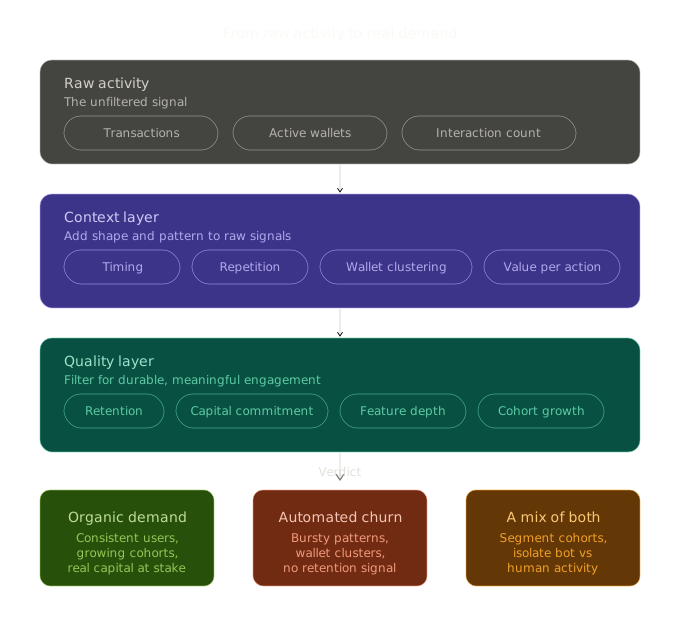
The next phase of on-chain analytics will be less about volume and more about context. As AI agents become normal across the crypto stack, the best dashboards will not be the ones with the most colourful lines. They will be the ones that tell users what those lines actually mean.
That is the bigger shift. Crypto is entering a period where activity may become easier to generate, but harder to interpret. In that environment, raw numbers become a starting point, not a conclusion.
And that may be the most important lesson of all. In a market full of clever software, counting wallets without analysing behaviour is a bit like judging a pub by the noise outside. Sometimes it is packed with regulars. Sometimes it is just the fruit machine.

A deep dive into how ETH treasuries + ETFs are rapidly absorbing supply, why their staking advantage matters, and what it could mean for ETH's price.

Best crypto portfolio management tools for retail investors compared - learn how CoinIQ delivers smarter, unified portfolio insights.

Discover peak-to-trough drawdown and effective strategies for managing your limits in cryptocurrency investments.